How We Compare Telehealth Services
By Paul Paradis · Last updated October 29, 2026 · Last reviewed October 29, 2026
Our “best” guides and comparison tables help you narrow down online therapy and psychiatry services. This page explains exactly where the figures in those tables come from, what we leave out, and where our method stops short, so you can judge how much weight to give them.
What we compare
- Price: the self-pay price each company lists, with first-month discounts shown separately from the regular price.
- Insurance: whether the company says it bills insurance, what it says insured members typically pay, and whether it gives receipts for out-of-network claims or accepts HSA and FSA cards.
- Format: messaging, live video, session length and how many live sessions a plan includes.
- Who provides care: licensed therapists, psychiatrists, nurse practitioners or non-clinical coaches, in the company’s own words.
- Billing terms: how often you are charged, auto-renewal and what happens if you cancel early.
- Public record: government actions involving a company, such as FTC orders or DEA rules that affect prescribing, taken from the agency’s own release.
Where the figures come from
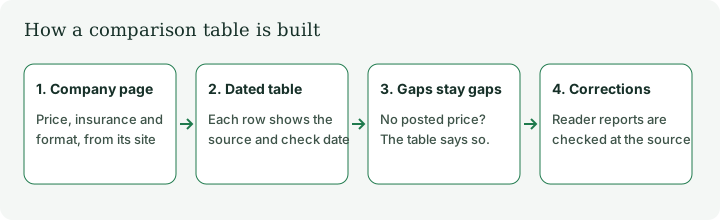
Prices and plan details come from each company’s own pricing, FAQ or help-center pages. Rules and dates come from primary sources such as CMS, the DEA, the Federal Register, HHS and state licensing boards. We link the page we used next to the figure or in the guide’s Sources section, so you can check it yourself.
Every price table shows the date we checked it. When a company does not publish a figure, such as a self-pay price that is only quoted after sign-up, the table says so instead of estimating one.
What we do not do
- No hands-on testing. We do not sign up for services, attend sessions or report on what a session felt like. Some larger review sites do this; we don’t, and we won’t imply that we have.
- No user surveys or star ratings. We don’t publish scores, because a single number would hide the trade-offs that matter most, such as insurance status or who provides care.
- No hand-placed affiliate links. As of October 22, 2026, no link on this site is an affiliate link we placed by hand and no company pays us to be listed or ranked, though a script from Sovrn Commerce (VigLink) that runs on every page may turn some ordinary links to outside stores and services into affiliate links that can earn us a commission at no extra cost to you. When it converts a link, our page code tags that link rel="sponsored" for search engines, but nothing on screen marks it as paid, so treat any outbound link as one that could earn us money. Our “best” and comparison guides do not score or rank services, and a possible commission never changes which services we list or what we say about them. Our affiliate disclosure explains how any future paid link would be marked.
Which pages use this method
Eight guides are built on it. Five are the “best” guides: online therapy platforms, online psychiatry, couples therapy platforms, medication management and teen therapy. Three are side-by-side comparisons: BetterHelp vs Talkspace, subscription vs pay-per-session, and text vs video therapy. The prices in them were checked on October 22, October 24 or October 29, 2026, and each table or sentence says which.
The teen therapy table is a good example of the format. It lists seven services, and each row gives the ages served, the formats offered, what a parent can see, insurance, price, the source page and the date it was checked. Where the linked company page does not say what parents can see, the cell says “Not stated on the linked page” rather than guessing.
What goes into a table row
- The figure, in the company’s terms. If Talkspace lists three weekly plans, the row shows all three prices, not an average.
- Regular price and first-month price kept apart. Calmerry, for example, appears as $57 to $90 a week by plan, with the lower first-month prices given in brackets.
- The source. Each row names the pricing, FAQ or help page the figure came from, so you can open the same page.
- The check date. Either in its own column or in the sentence beside the table.
- What could not be confirmed. When a site would not load or did not post a price on the check date, the row says that in plain words.
How we decide what to include
A service appears in a comparison table only if we could confirm its price or insurance terms on its own site on the check date. If we couldn’t, we name the service in the guide and explain what was missing, rather than filling the gap with a figure from a third-party review.
Order in a table is not a ranking. Our guides describe who each service tends to suit, because the right choice depends on your insurance, budget and what kind of care you need.
Limits of this method
- Prices and insurance networks change, sometimes weekly. The date on a table tells you how fresh it is; confirm the current price at sign-up.
- A company’s own pages describe what it offers, not how well it delivers. For quality, ask about a provider’s license and training, and check it with your state licensing board.
- What you pay with insurance depends on your plan, deductible and network. Call your insurer before your first visit.
How the cost estimator works
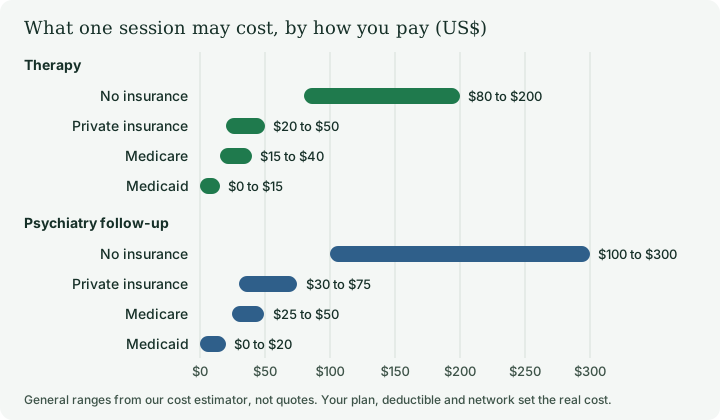
The online therapy cost calculator on this site is simple arithmetic, and you can see the inputs. For each kind of care it holds a low and a high per-session figure for each way of paying: no insurance, private insurance, Medicare and Medicaid. It multiplies that range by the sessions per month you choose and then by the number of months, and shows the low and high totals.
The ranges are general patterns, not quotes from any company. For online therapy they run from $80 to $200 a session without insurance and $20 to $50 with private insurance; for psychiatry follow-up visits, $100 to $300 and $30 to $75. A first psychiatry evaluation costs more, and the tool says so, giving about $225 to $500 without insurance from published prices. Employee assistance programs are handled separately, because they usually cover a set number of free sessions (often three to eight) and then stop. Wellness coaching gets no range at all: published coaching prices differ too much by format, so the tool shows dated examples (checked October 24, 2026) instead of an estimate.
How outbound links are handled
Every outside brand we link to is listed in one register file, and each one carries one of four statuses: no affiliate program, a program exists but we have not joined, active, or blocked. A small script reads that file. It adds the rel="sponsored" attribute and a disclosure note beside the first paid link only for brands marked active, and it removes “sponsored” from everything else. As of October 29, 2026, no brand in the register is marked active, which is why none of our “best” or comparison pages has a link marked sponsored.
Separately, the Sovrn Commerce (VigLink) script on every page can turn an ordinary outbound link into an affiliate link in your browser. Those links are not marked as paid in the page, and the comparison tables are written before, and without regard to, anything that script does.
How often figures are rechecked
Each guide gets a full review at least once a quarter. A guide moves up the queue sooner when a company changes its pricing, insurance acceptance or state availability, when a federal agency issues guidance that changes what the guide says, or when a reader sends a correction we can confirm. When a figure changes, the check date beside it changes too.
The free AI guide does not write or update these tables. It answers general questions and points readers to the guides, so a figure you see in a table always comes from the dated source named next to it.
Who does this work, and how to report an error
Guides are researched and written by our editor, Paul Paradis, who is not a clinician. Our behavioral health reviewer is listed on the reviewer page, and our wider process is described in our editorial standards.
If you spot an outdated price or a wrong detail, please contact us. We check the source and correct the page, along with its date.
If you are in crisis or may hurt yourself or others, call or text 988 or call 911.